In hazardous industrial environments such as oil & gas, mining, and chemical processing, equipment safety is strictly regulated to prevent ignition risks. While many professionals are familiar with ATEX certification in Europe, IECEx certification plays an equally critical role on a global scale.
So, what is IECEx certification, and when should you choose IECEx-certified equipment—especially for industrial communication systems like telephones and intercoms? This article provides a structured overview to help you make informed decisions.
IECEx Basics
IECEx stands for the IEC System for Certification to Standards Relating to Equipment for Use in Explosive Atmospheres. It is an international certification scheme developed by the International Electrotechnical Commission (IEC).
The primary goal of IECEx is to ensure that equipment used in explosive environments meets globally recognized safety standards. Unlike regional systems, IECEx facilitates international trade and simplifies compliance across multiple countries.
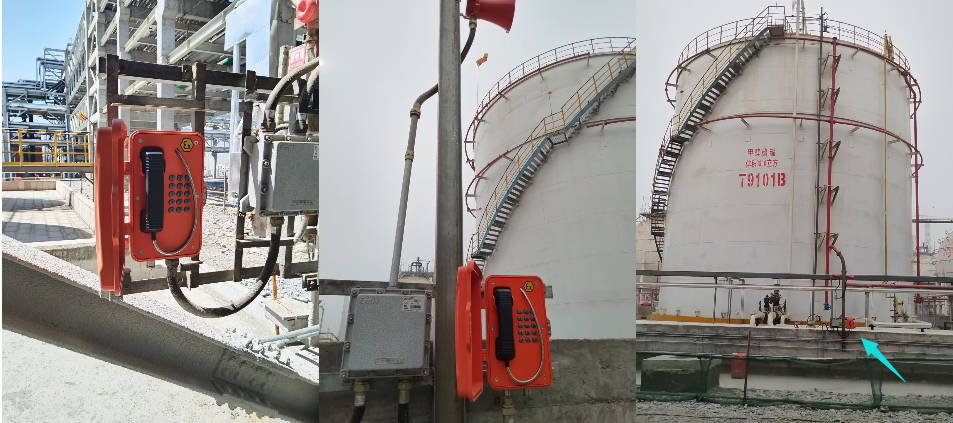
For industrial communication devices, IECEx certification confirms that equipment can safely operate in hazardous areas without becoming an ignition source.
Test and Certification Flow
The IECEx certification process is comprehensive and involves multiple stages:
-
Design Evaluation
Assessment of explosion protection concepts such as intrinsic safety (Ex i), flameproof (Ex d), or increased safety (Ex e).
-
Testing by ExCB (Certification Bodies)
Equipment is tested by IECEx-approved certification bodies to verify compliance with IEC standards.
-
ExTR (Test Report)
A detailed test report documents all evaluation results.
-
QAR (Quality Assessment Report)
Verifies that the manufacturer maintains a consistent quality management system.
-
Certificate of Conformity (CoC)
Issued once all requirements are met, confirming IECEx compliance.
This structured process ensures both product safety and manufacturing consistency.
Global vs Regional Standards
One of the key differences between IECEx and other certification systems lies in its global applicability:
-
IECEx (International)
Recognized in multiple countries, including Australia, the Middle East, and parts of Asia.
-
ATEX (European Union)
Mandatory for equipment used within the EU.
-
Other Local Certifications
Some countries may have additional requirements but often accept IECEx as a baseline.
For multinational projects, IECEx certification helps reduce duplication of testing and simplifies market entry.
It is often compared with iecx vs atex, where IECEx is seen as more globally adaptable, while ATEX is region-specific.
When to Choose IECEx
Selecting IECEx-certified equipment depends on several factors:
-
Global Project Deployment
If your project spans multiple countries, IECEx simplifies compliance.
-
Non-EU Markets
In regions outside Europe, IECEx is often preferred or required.
-
Standardization Strategy
Companies aiming for unified equipment standards across sites benefit from IECEx.
-
Integration with Safety Systems
Systems such as area of refuge communication system often require internationally recognized certifications.
-
Future Expansion
IECEx-certified equipment offers flexibility for future global projects.
In many cases, manufacturers provide dual certification (ATEX + IECEx) to maximize compatibility.
Case Examples
To better understand when IECEx certification is necessary, consider the following scenarios:
-
Oil & Gas Projects in the Middle East
IECEx-certified communication equipment is commonly required due to international project standards.
-
Mining Operations in Australia
IECEx is widely accepted and often mandatory for hazardous-area equipment.
-
Global Industrial Facilities
Multinational companies prefer IECEx to standardize equipment across different regions.
-
Underground and Confined Spaces
Systems like emergency communication or refuge areas rely on certified equipment for safety assurance.
These examples highlight how IECEx supports both compliance and operational efficiency.
Conclusion
IECEx certification is a globally recognized standard for ensuring the safety of equipment used in explosive atmospheres. For industrial communication devices such as telephones, it provides assurance of reliable and compliant operation across international markets.
Choosing IECEx-certified equipment is particularly beneficial for global projects, non-EU deployments, and companies seeking standardized safety solutions. In an increasingly interconnected industrial world, IECEx is not just a certification—it is a strategic advantage.


 Prisons & Correctional Facilities
 Transportation & Underground Infrastructure
 Critical Industrial & Energy Facilities
 Marine & Offshore
 Manufacturing Plant & Public Facilities